
Prolactin the mothering hormone

Picture: Prolactin-secreting cells

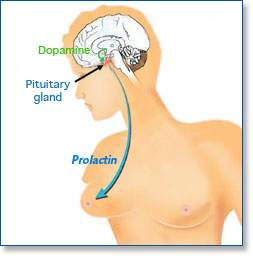
Prolactin, often called the "mothering" hormone, is secreted in the anterior pituitary. During pregnancy prolactin is essential for complete lobular development in the breast. Prolactin levels rise from a non pregnant baseline of 10-25 ng/mL to 200-400 ng/mL at term Progesterone antagonism from the placenta enables the prolactin level to rise without subsequent milk production.
Progesterone interferes with prolactin's activity on the cell receptor sites in the alveoli of the breast.With the birth of the placenta, and the sudden drop in pregnancy hormones; progesterone and estrogen, the elevated prolactin level brings in the milk supply. Prolactin is released in pulses directly related to stimulation of the areola or breast. "For any hormone to exert its biologic effects, however, specific receptors for the hormone must be present in the target tissue " Frequent feeding in the early days increases the number of prolactin receptor sites within the breast. The implication from research is that "the controlling factor in breastmilk output is the number of prolactin receptors [in the breast] rather than the amount of serum prolactin " These prolactin receptors are laid down in the first 3 months postpartum. The prolactin receptors in the breast allow abundant milk production to continue when total baseline prolactin levels drop over the first 3 to 4 months. Even with more "normal" baseline levels, breast stimulation continues the doubling of the declining baseline prolactin levels into the second year .
The prolactin receptor site theory raises serious concern over progesterone laden birth control methods when started within days of the birth. Depo-Provera (medroxyprogesterone acetate) shots are often given immediately postpartum, while the mother is still in the hospital. If progesterone is an antagonist to prolactin, logic dictates that progesterone shots, implants and pills would inhibit early establishment of milk production. Elevated prolactin levels in the early days of lactation help milk and receptor site production. Each nursing produces a doubling in serum prolactin levels. Prolactin level naturally rises in sleep states Night nursings help maintain an elevated baseline prolactin level. Thus, it is unwise for a mother to skip breastfeedings at night (having someone else give bottles) if she wants to develop a good milk supply. Frequent prolactin release inhibits follicle stimulating hormone (FSH) and luteinizing hormone (LH), causing lactational amenorrhea preventing the return of fertility Prolactin is biologically potent for the infant. Milk prolactin levels are highest in colostrum and transitional milk. In mature milk the highest prolactin concentration is in the foremilk. In the infant gut, prolactin effects fluid and electrolyte exchange in particular, sodium, potassium, and calcium.
#iamstillawoman #prolactin #breastfeeding #mothersmilk 

Comments

Popular posts from this blog

"Hard nipples" - areola or nipple skin

Someone once wrote"... when i get really cold, or get goosebumbs all over my body, the whole things really scrunch up, like, my entire areola scrunches itself up into a wrinkled little mound. it looks really weird and ugly, and i haven't ever seen other people's breasts do it. what is wrong with my areola/nipples??" The answer: Well nothing is wrong. This is what my areola does too. It's a normal reaction to the coldness or to irritation / stimulation. The little muscles in the areola do a similar goosebump thing as your other skin can do. People often call this phenomenon "hard nipples". Also note that skin on areola has less feeling or sensation to it than other areas of your body. If the areola was very sensitive, then breastfeeding would probably be quite uncomfortable because the baby pulls and tugs it! The nipples are sensitive but the sensitivity changes with hormonal changes, such as occur at mestrual cycle or pregnancy. Also this v...

Mastectomy Drain Breast Cancer Treatment

The  purpose of drains after mastectomy  is to drain away the fluid that can gather in the armpit region or around the scar on the chest wall. Some people after mastectomy also find that fluid gathers around the shoulder blade area on their back - this seems more common if the muscle from the back has been used for  breast reconstruction  at the time the mastectomy was done. When mastectomy is done - and especially if the lymph nodes are removed from the axilla or armpit - then there is a lot of tissue fluid and lymph fluid left with no where to go. This fluid normally flows through the lymph channels but if they are cut then it can escape into the normal skin and muscle tissues. Your surgeon will place drains under your skin after mastectomy. These drains gather up the fluid and remove it to a bottle (or bottles) that you carry around with you. Some people use a  belt clip to attach the drain  to their waistband - making them more mobile. Others car...

Pancreatic Cancer breakthrough

Published Today By  Ana Sandoiu Fact checked  by Jasmin Collier New research now published in the  Journal of Natural Products  shows that a vine compound is highly effective in the fight against treatment-resistant pancreatic cancer cells. #cancer #cells #pancreaticcancer #breakthrough #natural #journalofnaruralproducts #cure #survivor #iamstillawoman #Anasandiou #jasmincollier A type of rainforest vine may hold the key to effective cancer treatments.  Pancreatic cancer  is notoriously difficult to treat, and the condition has a poor outlook. According to the American Cancer Society (ACS), the 5-year survival rate for people with early-stage exocrine pancreatic cancer is  12–14 percent . A  new study  explains why that is and offers a potential solution. Gerhard Bringmann, a professor of organic chemistry at the Julius-Maximilians-Universität Würzburg in Germany.  Specifically, human pancreatic ...